Visuospatial Thinking
Visuospatial ability is the ability to mentally represent and manipulate objects in three dimensions (3D), a skill used in each of our daily activities.
We use our visuospatial thinking to measure and control, for example, the actual distance between two objects, as well as the area that separates those two objects.
The visuospatial capacities also help us to orient ourselves and create reference points, which will allow us to mentally turn towards any destination that we need to focus on, as well as to prepare routes or paths to follow in some displacement. Thanks to this thought, we can schedule future activities and movements.
Visuospatial activity is made up of three major components:
1- Bilateral Integration:
Bilateral integration consists of the orderly coordination of the two parts of the body. This includes the hands, eyes, arms, legs, feet, and brain.
2- Laterality:
The brain begins to recognize that perhaps a hand or foot on one side is better at certain skills than the hand or foot on the other side. Thus, the brain determines the priority and use to a greater extent of those organs and systems that it considers most capable in the development of each daily activity.
There can also be cases of mixed laterality, where certain organs, for example, can better carry out an activity and its complementary ones, be safer for the achievement of another challenge.
and
3- Directionality:
Directionality is the ability to interpret directions to the left or right in outer space, that is, to be able to recognize right and left beyond oneself.
The proper functioning of this system is related to balance, coordinated body movements, the ability to move around the environment, without colliding with objects, follow spatial directions, as well as understand the orientation of alphanumeric symbols.
Exercise 9 - Clocks
Which clocks show the correct time?
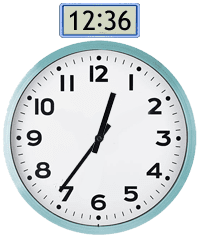
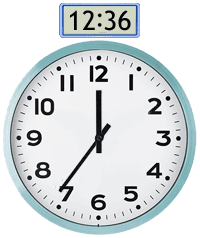
a: First clocks
b: Second clocks
c: None
d: Both
The first clocks: 36 minutes have passed after 12 o'clock; therefore, the hour hand will be between hour 12 and hour 1 and the minute hand will be a point after 7 (35 min).
Exercise 10 - Scales
At what point on the course is the athlete?

a: Km 194,25
b: Km 186
c: Km 183,25
The athlete has covered 75 kms of the total 100 kms (3/4 parts of 100). Answer "b": Km 186.
Spatial Reasoning Exercise using Two Elements