Mechanical Reasoning
Mechanical reasoning measures the ability to understand basic mechanical principles of machinery, tools, and motion.
Mechanical reasoning tests measure your knowledge of straightforward mechanical and physical concepts.
Mechanical and Physical Reasoning Examples
Exercise 1
Which direction will cog "D" be going?

1. Same as "A"
2. Same as "B"
3. Same as "C"
Let's see:

"A" goes clockwise.
"B" goes counterclockwise.
"C" goes clockwise.
"D" goes counterclockwise.
Cog "D" will be going the same as "B". (Answer Choice 2)
Exercise 2
Which chain will hold the sign?

1. A 2. B 3. Both 4. Neither
Because of the weight of the sign, chain "B" will hold it.
Exercise 3
If Triangle "A" weighs 10 kg, how much does Triangle "B" weigh?

1. 10 Kg
2. 20 Kg
3. 25 Kg
4. 15 Kg
Because of the point of support is centered and the triangles are at the same level, Triangle "B" weighs the same as "A" (Answer choice 1: 10 kg).
Exercise 4
Which bike will go faster?
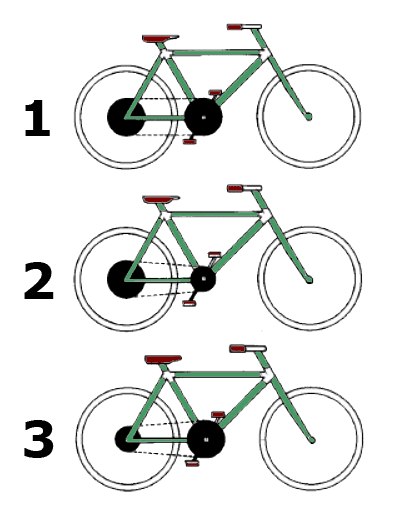
1. Bicycle with the wheel sprocket and the pedal flywheel of equal diameter
2. Bicycle with the wheel sprocket larger than the pedal flywheel
3. Bike with the wheel sprocket smaller than the pedal flywheel
A small sprocket will make the rear wheel of the bike spin more times, i.e. faster. The larger flywheel on the pedal requires less effort. (Answer 3: Bike with the wheel sprocket smaller than the pedal flywheel).
Communicating Vessels - Principle of Siphon