Classical Music
Classical music is a broad term that usually refers to music produced in, or rooted in the traditions of Western ecclesiastical and concert music, encompassing a broad period from roughly the 9th century to present times. The central norms of this tradition became codified between 1550 and 1900, which is known as the common practice period. It is still played by many of today's musicians.
When used as a synonym for Western art music, the term encompasses a range of musical styles and approaches, ranging from compositional techniques (such as the fugue) to entertaining operettas.
European classical music is largely distinguished from many other non-European and popular musical forms by its system of staff notation, in use since about the 16th century. Western staff notation is used by composers to prescribe to the performer the pitch, speed, meter, individual rhythms, and exact execution of a piece of music. This leaves less room for practices such as improvisation and ad libitum ornamentation that are frequently heard in non-European art music (compare Indian classical music and Japanese traditional music) and popular music.
Public taste for and appreciation of formal music of this type waned in the late 1900s, in the United States and United Kingdom in particular. Certainly, this period saw classical music fall well behind the immense commercial success of popular music, in the opinion of some, although the number of records sold is not necessarily indicative of the popularity of classical music.
The term "classical music" did not appear until the early 19th century, in an attempt to "canonize" the period from Johann Sebastian Bach to Beethoven as a golden age.
Ludwig van Beethoven (1770–1827)
Representative Works
Piano Sonata No. 7 in C minor, Op. 10, No. 3,
Bagatelle No. 25 in A minor, WoO 59 "Für Elise",
Symphony No. 9 in D minor, Op. 125 "Choral",
Symphony No. 5 in C minor, Op. 67,
Symphony No. 6 in F major, Op. 68 "Pastoral",
Piano Sonata No. 14 in C-sharp minor, Op. 27, No. 2 "Moonlight",
Piano Sonata No. 8 in C minor, Op. 13 "Pathétique",
Symphony No. 3 in E-flat major, Op. 55 "Eroica".
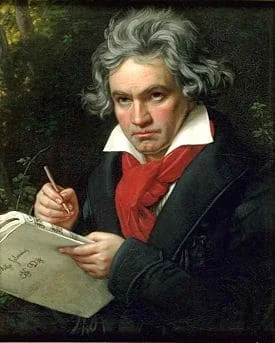
Biography
Ludwig van Beethoven was baptized on December 17, 1770, in Bonn. His family originated from Brabant in Belgium. His father was a musician at the Court of Bonn with a definite weakness for drink. His mother was always described as a gentle, retiring woman with a warm heart; Beethoven referred to her as his "best friend". The Beethoven family consisted of seven children, but only the three boys survived, of whom Beethoven was the eldest.
On March 26, 1778, at the age of seven and a half, Beethoven gave his first known public performance in Cologne. His father announced that he was six years old; because of this, Beethoven always believed he was younger than he actually was. Even much later, when he received a copy of his baptism certificate, he believed it belonged to his brother Ludwig Maria, who was born two years before him and died in childhood.
In 1782, before the age of 12, Beethoven published his first work: 9 Variations in C minor for Piano on a March by Ernst Christoph Dressler (WoO 63). The following year, in 1783, Christian Gottlob Neefe wrote in the Magazin der Musik about his student: "If he continues like this, he will undoubtedly be the new Mozart."
In 1792, Beethoven moved to Vienna, where he studied for a time with Joseph Haydn, his hopes of studying with Mozart having been shattered by Mozart's death the previous year. Beethoven received additional instruction from Johann Georg Albrechtsberger (Vienna's pre-eminent counterpoint instructor) and Antonio Salieri. By 1793, Beethoven had established a reputation in Vienna as a piano virtuoso. His first works with opus numbers—a set of three piano trios—appeared in 1795. He settled into the career pattern he would follow for the remainder of his life: rather than working for the church or a noble court (as most composers before him had done), he supported himself through a combination of annual stipends or single gifts from members of the aristocracy; income from subscription concerts, public performances, and lessons; and proceeds from the sale of his works.
Around 1796, Beethoven began to lose his hearing. He suffered from a severe form of tinnitus—a constant ringing in his ears—that made it difficult for him to perceive and appreciate music; consequently, he also began avoiding conversation. He lived for a time in the small Austrian town of Heiligenstadt, just outside Vienna, where he wrote the Heiligenstadt Testament, which records his resolution to continue living for and through his art. Over time, his hearing loss became profound. There is a well-attested story that, at the end of the premiere of his Ninth Symphony, he had to be turned around by a soloist to see the tumultuous applause of the audience; hearing nothing, he began to weep. Beethoven's hearing loss did not prevent him from composing music, but it made public performances, which were lucrative sources of income, increasingly difficult. After Beethoven lost custody of his nephew, he went into a physical and emotional decline that led to his death on March 26, 1827, during a severe thunderstorm.